
Few things are more frustrating than seeing a strange error code when everything was working normally a moment ago. If you have searched for codes error RCSDASSK, you have probably noticed that there is surprisingly little reliable information about what the term actually means.
The important thing to understand is that RCSDASSK does not appear to be a standardized error code with one universal definition. Different websites describe it as a software, system, application, or integration-related error, but there is no clear official documentation tying the code to one specific operating system, application, or manufacturer.
That makes the context surrounding the error especially important. Where did it appear? What were you doing immediately beforehand? Did it start after an update, installation, login attempt, or configuration change?
This guide explains how to approach codes error RCSDASSK without relying on guesswork.
What Is Codes Error RCSDASSK?
Codes error RCSDASSK appears to be an uncommon or application-specific error identifier rather than a universally recognized Windows, macOS, Linux, Android, or browser error.
Some online guides describe RCSDASSK as a system-level or application-level problem involving configuration files, software components, permissions, or communication between services. However, these explanations are not backed by a single authoritative vendor specification.
In practical terms, this means you should not assume that the letters in “RCSDASSK” have a fixed technical meaning.
Instead, treat the code as a clue. The surrounding error message, application name, log entry, and action that triggered it are usually much more useful for identifying the real problem.
Why Does the RCSDASSK Error Appear?
Because there is no verified universal definition, several different technical problems could potentially produce an unfamiliar error identifier like this.
Common possibilities include:
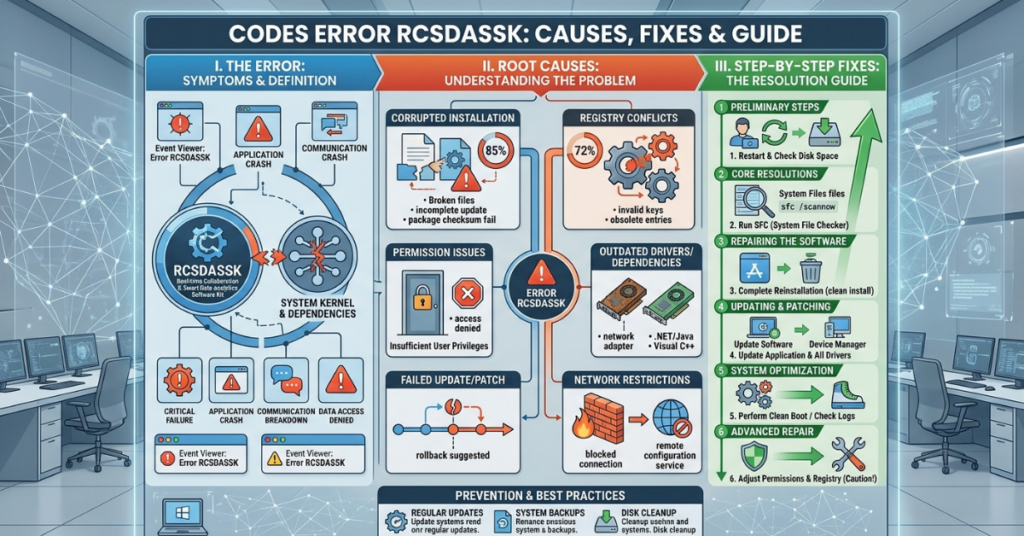
1. Corrupted or Missing Files
Applications rely on configuration files, libraries, scripts, and other components to function correctly. If an installation is incomplete or a required file becomes damaged, the application may fail when it tries to access it.
This can happen after:
- An interrupted software installation
- A failed update
- An unexpected system shutdown
- Manual deletion of application files
- Disk or storage problems
2. Outdated Software
An old application running on a newer operating system can sometimes encounter compatibility problems.
Likewise, an outdated operating system, driver, browser, or dependency may prevent newer software from functioning correctly.
If the codes error RCSDASSK started immediately after another component was updated, compatibility should be one of the first things you investigate.
3. Permission or Configuration Problems
Some applications need permission to access particular files, folders, network resources, or system services.
A change in security settings, user permissions, firewall rules, or application configuration can prevent that access.
4. Third-Party Software Conflicts
Antivirus programs, firewalls, browser extensions, VPNs, system optimization utilities, and other background applications can occasionally interfere with software.
If the error disappears when a particular third-party service is disabled, that provides an important clue about the source.
5. Network or Authentication Issues
If RCSDASSK appears while logging into an online service, syncing data, connecting to an API, or accessing a remote system, the problem may involve connectivity, authentication, permissions, or server-side configuration.
In this situation, reinstalling the entire operating system would be unnecessary. The network or application logs are more useful starting points.
How to Troubleshoot Codes Error RCSDASSK
Before making major changes to your computer, follow a structured troubleshooting process.
Step 1: Record the Complete Error
Do not write down only “RCSDASSK.”
Take a screenshot or copy the complete message. Also record:
- The application or website showing the error
- Your operating system
- What you were doing when it appeared
- The approximate time it occurred
- Whether the error happens every time
- Any recent updates or installations
The extra information can make the difference between a quick fix and hours of unnecessary troubleshooting.
Step 2: Restart the Application
A temporary application failure can sometimes disappear after restarting the program.
Close the application completely, reopen it, and repeat the action that originally produced the error.
If the problem returns immediately, continue with the next steps.
Step 3: Restart Your Device
A full restart can clear temporary processes, memory conflicts, and background services that did not initialize correctly.
It is a simple step, but it is worth trying before making more complicated changes.
Step 4: Check for Software Updates
Look for updates for the affected application and your operating system.
If the problem began immediately after an update, check whether the developer has released a newer patch or documented a known issue.
Avoid downloading unofficial “error fixer” programs simply because they claim to repair RCSDASSK.
Step 5: Check Available Storage
Low disk space can interfere with installations, updates, temporary files, and application processes.
Make sure your system has enough free storage and remove unnecessary temporary files if space is critically low.
Step 6: Check Permissions and Security Software
If the error happens when an application tries to access a file or network resource, review its permissions.
You can also test whether security software is interfering, but do not permanently disable antivirus or firewall protection just to make the error disappear. If testing requires temporarily changing a security setting, restore the protection afterward.
Step 7: Examine System or Application Logs
Logs can provide information that the visible error message does not.
On Windows, Event Viewer can help identify application and system failures. Other operating systems and applications have their own logging tools.
Look for entries created around the exact time the RCSDASSK message appeared.
Useful details include:
- Application name
- Faulting module
- Error timestamp
- Exception information
- Network or authentication messages
- File or permission errors
Step 8: Reinstall the Affected Application
If the problem is limited to one application and the previous steps have not helped, reinstalling that application may repair damaged or missing components.
Before uninstalling it, check whether the application stores important local files or settings that need to be backed up.
What Not to Do When You See RCSDASSK
Searching for an unfamiliar error can lead you to websites offering questionable downloads or dramatic explanations.
Be careful with advice that tells you to:
- Download an unknown “RCSDASSK repair tool”
- Install random DLL files
- Edit the Windows Registry without understanding the change
- Disable security software permanently
- Delete system files
- Enter passwords or recovery information into an unfamiliar website
- Reinstall the entire operating system immediately
An unfamiliar error code does not automatically mean your computer is infected or permanently damaged.
The safest approach is to identify the application that generated the message first.
How to Find the Real Cause
The most effective troubleshooting question is not simply, “What does RCSDASSK mean?”
Instead, ask:
“Which program generated RCSDASSK, and what was that program trying to do?”
For example, consider these scenarios:
| Where the error appears | What to investigate |
| During software installation | Installer files, permissions, storage |
| When opening an application | Application files, dependencies, compatibility |
| During login | Authentication, permissions, network |
| During an update | Update package, compatibility, failed installation |
| On a website | Browser, scripts, extensions, server response |
| During data synchronization | Network, API, account permissions |
| After a system change | Recent update, driver, configuration |
This approach is much more reliable than assuming the code has one fixed meaning.
When Should You Contact Technical Support?
If basic troubleshooting does not solve the problem, contacting the software developer, IT administrator, or service provider may be the best option.
Before contacting support, collect:
- A screenshot of the complete error.
- The exact steps that reproduce it.
- Your operating system and version.
- The application name and version.
- Relevant log information.
- Details about recent updates or configuration changes.
If several users are experiencing the same error at the same time, mention that as well. It could indicate a service-side problem rather than an issue with your individual device.
Is RCSDASSK a Virus?
There is no reliable evidence that the string “RCSDASSK” itself is a virus or malware name.
An error message alone cannot establish whether a device is infected. If you are concerned about malware, use your operating system’s trusted security tools and investigate the actual file, process, or application associated with the message.
Do not download an unfamiliar program just because a website claims it can “remove RCSDASSK.”
Can Reinstalling Windows Fix the Error?
It might resolve a genuine system corruption problem, but reinstalling Windows should not be your first response to an unfamiliar error code.
A clean installation is a major step that can remove applications, settings, and personal data if it is performed incorrectly.
First determine whether the error is actually coming from Windows. If it appears only inside one application or website, troubleshooting that specific application is usually more appropriate.
Frequently Asked Questions
What does codes error RCSDASSK mean?
There is no verified universal definition for codes error RCSDASSK. Online sources associate the term with different software and system problems, so the application and complete error message are essential for determining its meaning.
Is RCSDASSK a standard Windows error?
RCSDASSK does not appear to be a standard, widely documented Windows error identifier. If it appears on a Windows computer, identify which application or service generated the message before assuming that Windows itself is responsible.
How can I fix the RCSDASSK error?
Start by restarting the affected application and device. Then check for software updates, available storage, permissions, security software conflicts, and relevant system or application logs. If the problem continues, reinstall the affected application or contact its support team.
Can outdated software cause RCSDASSK?
It is possible for outdated software or incompatible components to produce unusual error messages. If RCSDASSK began after an operating-system or application update, check compatibility and look for patches from the software developer.
Should I download an RCSDASSK repair tool?
No. There is no reason to trust an unknown repair utility simply because it uses the RCSDASSK name. Download software only from a trusted developer or official source.
Does RCSDASSK mean my computer is hacked?
Not necessarily. An unfamiliar error code does not prove that your computer has been compromised. If you suspect malware, investigate the actual application, process, or file involved and use reputable security software.
What information should I give technical support?
Provide the complete error message, screenshot, application and version, operating system, time of occurrence, steps that reproduce the problem, and any relevant log information.
Conclusion
The biggest takeaway about codes error RCSDASSK is that you should not assume the code has one universal technical meaning. Current online information gives several different explanations, while no clear authoritative specification establishes RCSDASSK as a standard error code.
Rather than guessing what the letters represent, focus on the context: where the error appeared, what you were doing, what changed recently, and what the system logs reveal.
Start with simple troubleshooting, keep your software updated, avoid suspicious repair tools, and escalate the issue when the available evidence points to an application or server-side problem. With that approach, even an unfamiliar error like RCSDASSK becomes much easier to investigate.