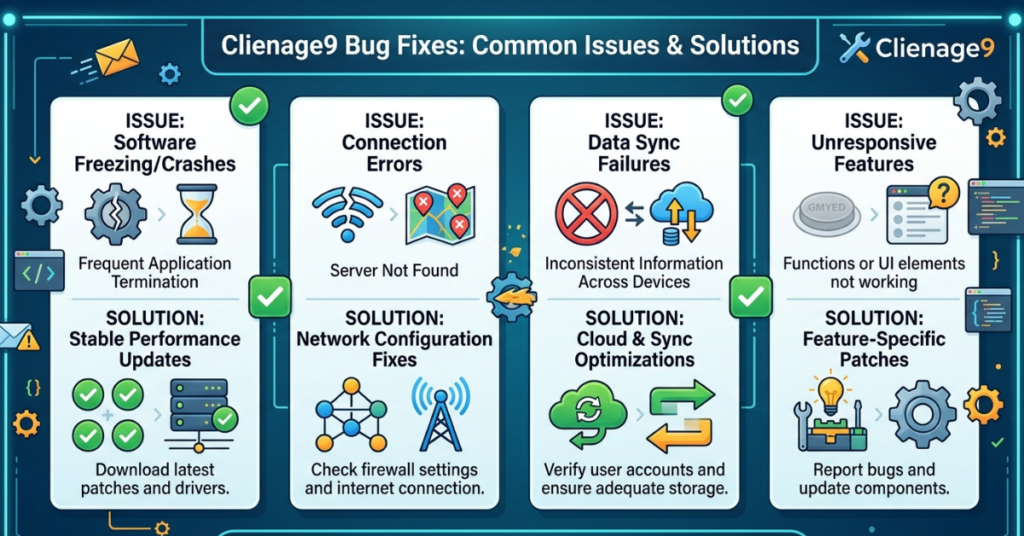

Few things are more frustrating than sitting down to play and spending the first 20 minutes trying to figure out why something is broken. If you’re searching for clienage9 bug fixes, you’re probably dealing with an issue such as stuttering, loading problems, graphical glitches, crashes, or connection instability.
Clienage9-related information online is still somewhat limited and inconsistent. Some pages describe Version 9 as a gaming-focused platform with performance and gameplay tools, while other sources describe it more like a client-management methodology. Because of that confusion, troubleshooting should start with the exact version, platform, and problem you’re experiencing rather than relying on a random fix from a forum.
The good news is that many software problems have fairly straightforward causes. Outdated drivers, corrupted files, incompatible settings, temporary cache data, and network problems can all create symptoms that look like serious bugs.
Let’s break down the most useful troubleshooting steps.
What Are Clienage9 Bug Fixes?
The term clienage9 bug fixes generally refers to solutions intended to resolve reported problems associated with Clienage9 or its Version 9 environment.
Public pages discussing Clienage9 mention issues such as:
- Performance drops and micro-stuttering
- Graphical or UI glitches
- Loading problems
- Connection interruptions
- Compatibility issues after updates
- Problems caused by outdated drivers or cached data
However, not every problem reported online should automatically be considered an official Clienage9 bug. Some may actually come from the user’s computer, operating system, graphics driver, network, or configuration.
That’s an important distinction when troubleshooting.
Common Clienage9 Problems to Check First
Before changing advanced settings, identify exactly what is going wrong.
1. FPS Drops and Micro-Stuttering
Performance problems are among the most noticeable issues in any graphics-heavy application. A game may technically remain playable while still feeling inconsistent because of sudden frame-time spikes.
If you’re experiencing stuttering, check:
- GPU and CPU usage
- Available RAM
- Background applications
- Graphics-driver version
- In-game graphics settings
- Temperature and thermal throttling
- Shader or temporary cache data
Lowering demanding graphics options can also help determine whether the problem is hardware-related.
2. Loading or Startup Problems
A program that freezes during startup doesn’t necessarily need to be completely reinstalled.
Try these steps in order:
- Close the application completely.
- Restart your computer.
- Check whether an update is available.
- Verify the application’s files if your platform provides that option.
- Temporarily disable unnecessary overlays.
- Launch the application again.
If the problem began immediately after an update, that timing is useful evidence. It may indicate an update-related compatibility problem rather than a hardware failure.
3. UI or Graphical Glitches
Missing interface elements, flickering textures, unusual rendering, or incorrect visual elements can sometimes be caused by graphics drivers or cached shader data.
Start with the simplest solution: update your graphics driver through the manufacturer’s official software or website.
If the issue appeared immediately after a driver update, however, the newest driver isn’t always the best driver. In that situation, checking the application’s known compatibility information may be more useful than repeatedly installing different versions.
4. Connection Drops
If Clienage9-related gameplay or online features repeatedly disconnect, don’t immediately assume the application itself is broken.
Check your connection first.
A useful troubleshooting sequence is:
- Test another online application.
- Restart your router if appropriate.
- Prefer a wired connection when possible.
- Stop bandwidth-heavy downloads.
- Check whether other users on the same network have problems.
- Look for server-status information if an official source exists.
If several players are reporting the same outage at the same time, the problem may be server-side and changing your local settings won’t solve it.
How to Troubleshoot Clienage9 Bug Fixes Step by Step
When several things appear to be wrong at once, random troubleshooting can make the situation worse. A systematic approach is much more effective.
Step 1: Identify When the Problem Started
Ask yourself:
- Did the problem begin after an update?
- Did you install a new driver?
- Did you change graphics settings?
- Did you install another application?
- Does the problem happen every time?
- Does it happen only during online play?
The answer can quickly narrow down the likely cause.
Step 2: Restart Your System
It sounds basic, but restarting can clear temporary processes and apply pending system changes.
If you’ve recently installed a graphics driver or major software update, a restart is especially worthwhile.
Step 3: Update the Software
Check for the latest legitimate version through the official distribution channel.
Avoid downloading supposed “bug-fix” files from random websites. An unofficial patch can create more problems than it solves and may expose your system to unwanted software.
Step 4: Update Graphics Drivers
For graphical problems, make sure your NVIDIA, AMD, or Intel graphics driver is supported and up to date.
Don’t rely solely on a random driver download page. Use the manufacturer’s official support channel whenever possible.
Step 5: Verify or Repair Files
If your gaming platform provides a file-verification or repair function, use it before reinstalling everything.
This can identify damaged or missing files without requiring a complete fresh installation.
Step 6: Test With Lower Settings
Temporarily reduce demanding settings such as:
- Shadows
- Global illumination
- Reflections
- Particle effects
- Texture quality
- Resolution
- Anti-aliasing
If performance improves dramatically, you’ve learned something useful: the problem may be related to rendering load rather than a fundamental software failure.
Should You Clear the Cache?
Cache files can occasionally become outdated or corrupted after software updates.
If official troubleshooting instructions recommend clearing a particular cache, follow those instructions carefully. Don’t randomly delete folders simply because their names contain words like “cache” or “temp.”
A safer approach is to:
- Close the application.
- Find the documented cache location.
- Back up important configuration files if necessary.
- Remove only the recommended cache data.
- Restart the application.
- Allow it to rebuild the required files.
The exact location can vary by operating system and application version, so generic instructions should not be treated as universal.
When a Clienage9 Update Causes New Problems
Ironically, an update designed to improve stability can sometimes introduce a new compatibility problem.
This happens with software in general. A change that fixes one system configuration may behave differently on another combination of hardware, drivers, and operating-system settings.
If your problem started immediately after an update:
- Record the exact version.
- Note the error message.
- Check official release notes.
- Look for confirmed known issues.
- Check community reports for similar symptoms.
- Avoid unofficial patches unless they come from a trustworthy source.
- Contact official support if the issue persists.
This approach is much more useful than changing ten settings at once.
How to Tell Whether the Problem Is on Your PC
One of the most important troubleshooting skills is separating software problems from hardware or network problems.
For example, if several unrelated games suddenly begin stuttering, the problem probably isn’t limited to Clienage9.
Look for patterns:
Likely application-specific problem:
- Only Clienage9 has the issue.
- The problem began after a Clienage9 update.
- Other applications work normally.
Potential system problem:
- Multiple games have performance problems.
- Your entire computer becomes unusually slow.
- Temperatures are unusually high.
- Other graphics applications also crash.
Potential network problem:
- Multiple online services disconnect.
- Other devices on the same network lose connectivity.
- Your connection becomes unstable at the same time.
This simple comparison can save hours of unnecessary troubleshooting.
What Not to Do When Fixing Clienage9
Sometimes the wrong troubleshooting method can create a bigger problem.
Avoid:
- Downloading unofficial executable “fixes”
- Installing unknown DLL files
- Disabling security software permanently
- Deleting system folders without knowing what they contain
- Changing multiple advanced settings simultaneously
- Using registry cleaners without a clear reason
- Reinstalling the operating system as a first resort
A good troubleshooting process should be reversible. Make one change, test the result, and only then move to the next step.
Are All Reported Clienage9 Fixes Official?
No. This is an important point.
Several websites currently publish pages about Clienage9 bug fixes, but the available information does not consistently distinguish between official release information, personal testing, and third-party claims. One current third-party guide even states that there are no officially confirmed public patch notes, which conflicts with other pages that present detailed fixes as established facts.
Because of this inconsistency, readers should verify important claims against an official developer announcement, release note, or trusted distribution platform before installing software or making significant system changes.
Frequently Asked Questions
What are the most common Clienage9 bugs?
Reported problems include performance stuttering, graphical glitches, loading issues, and connection problems. However, publicly available information is not consistent enough to treat every reported issue as an officially confirmed Clienage9 bug.
How can I fix Clienage9 stuttering?
Start by restarting your system, checking graphics drivers, closing unnecessary background applications, and lowering demanding graphics settings. If the problem continues, investigate whether other applications experience similar performance issues.
Should I reinstall Clienage9 if it crashes?
Not immediately. First try restarting the system, updating the software, verifying files, and checking for known compatibility problems. Reinstallation is better treated as a later troubleshooting step.
Can outdated graphics drivers cause Clienage9 problems?
Yes. Outdated or incompatible graphics drivers can cause crashes, rendering problems, stuttering, and visual glitches in graphics-intensive applications.
Should I download third-party Clienage9 bug-fix files?
It’s best to avoid unofficial executable files, DLL replacements, or modified installers. Use official updates and trusted support channels whenever possible.
Where can I find confirmed Clienage9 updates?
Look for release information through the official source associated with the software or game and its legitimate distribution platform. Be cautious when a third-party article presents unverified information as an official patch note.
Conclusion
Finding the right clienage9 bug fixes starts with identifying the actual cause instead of applying random solutions. Performance problems, loading failures, graphical glitches, and connection issues can have very different causes, so troubleshooting should be systematic.
Start with the basics: restart your system, check updates, verify files, review graphics drivers, and test your settings. If the issue appeared after a specific update, pay particular attention to release information and confirmed reports.
Most importantly, don’t assume every solution you find online is official. Because publicly available Clienage9 information is currently inconsistent, verify significant fixes through trustworthy sources before installing unfamiliar software or changing important system settings.
A little patience and a methodical approach can often turn a frustrating technical problem into a straightforward fix.