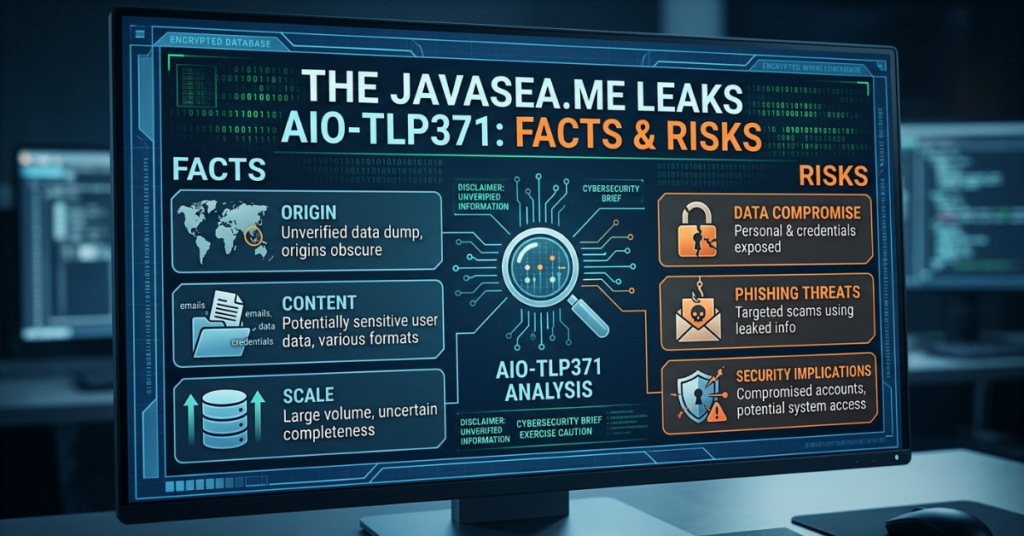

A strange cybersecurity-related keyword can spread across search engines surprisingly quickly. One example is thejavasea.me leaks aio-tlp371, a phrase that has appeared in online discussions and articles and has left many people wondering whether it refers to a major data breach, a leaked database, or simply an archive identifier.
The important thing is not to assume that a technical-looking name automatically represents a confirmed cyberattack. Current public reporting describes AIO-TLP371 inconsistently, and available evidence does not independently establish its exact origin, contents, authenticity, or scope.
So, what does the term actually mean, and should you be concerned? Let’s separate the facts from the speculation.
What Is thejavasea.me Leaks AIO-TLP371?
The phrase thejavasea.me leaks aio-tlp371 appears to combine the name of a website, the word “leaks,” and an identifier called AIO-TLP371.
Based on publicly available discussions, AIO-TLP371 appears to be used as an archive, package, or release-style label associated with leak-related material. However, that does not prove that it represents a conventional database breach or that every claim made about its contents is genuine.
There is currently no reliable public evidence establishing all of the following:
- The original source of the material
- Who created or uploaded it
- Whether the material is authentic
- Whether the collection is complete
- How many people may be affected
- Whether the material was distributed with consent
- Whether the label represents a conventional cybersecurity breach
That distinction is important because online posts can repeat the same unverified claim many times until it appears to be established fact.
What Does AIO-TLP371 Mean?
The name can be broken down into several parts, but its exact meaning has not been officially documented.
What Does AIO Mean?
“AIO” commonly means All-In-One in technology communities. It can be used to describe a bundle containing multiple files, resources, tools, or datasets.
In this case, however, interpreting AIO as “All-In-One” should be treated as a reasonable interpretation rather than an officially confirmed definition.
The abbreviation itself tells us very little about whether the underlying material is legitimate or authentic.
What Does TLP Mean?
This is where things become particularly confusing.
In legitimate cybersecurity, TLP commonly refers to the Traffic Light Protocol, a framework used to communicate how sensitive security information may be shared.
The official FIRST standard currently recognizes four TLP labels:
- TLP
- TLP
- TLP
- TLP
FIRST states that only the labels defined in its standard are valid TLP labels.
Therefore, AIO-TLP371 is not an official Traffic Light Protocol classification. The “TLP371” portion should not be confused with the professional cybersecurity standard.
What Does 371 Represent?
The number “371” appears to function more like an identifier, batch number, release number, or archive label in online discussions.
Its exact meaning has not been reliably established.
This is a good example of why readers should avoid assigning technical meanings to unexplained labels simply because they look official.
Is AIO-TLP371 a Confirmed Data Breach?
There is not enough reliable evidence to describe AIO-TLP371 as a confirmed conventional data breach.
Some online articles describe it as an alleged archive or collection, while others make broader claims about leaked information. However, those descriptions do not amount to independent technical verification.
A genuinely confirmed breach would normally have stronger evidence, such as:
- Identification of the affected organization or service
- Confirmation from the organization itself
- Technical analysis by reputable security researchers
- Evidence showing what information was exposed
- A credible timeline for the incident
- Reliable information about affected users
Without that evidence, it is more accurate to call AIO-TLP371 an unverified leak-related label rather than a confirmed global cyber incident.
Why Are There So Many Conflicting Claims?
One of the biggest problems with trending leak keywords is information duplication.
A website may publish an article based on another article, which gets copied by another site, and eventually dozens of pages appear to confirm the same story. But if all of those pages ultimately rely on one unverified claim, the number of articles does not make the claim more reliable.
Search results for related AIO-TLP identifiers demonstrate this problem. Different pages provide different descriptions of what the packages supposedly contain, while some explicitly acknowledge that the information has not been independently verified.
Things You Should Not Automatically Believe
Be cautious when you see claims such as:
- “Millions of accounts were leaked.”
- “The entire database is available.”
- “All files have been verified.”
- “This is an official TLP classification.”
- “You can safely download the archive.”
- “Your information is definitely included.”
Unless a trustworthy source provides supporting evidence, these statements should be treated as claims rather than established facts.
What Are the Cybersecurity Risks?
Even when the underlying leak claim is uncertain, interacting with unknown leak-related websites can create genuine security risks.
Malware and Malicious Downloads
Unknown archives can contain malicious executables, scripts, or documents. A person trying to investigate a suspicious leak may accidentally install malware instead.
This is particularly risky when websites encourage users to disable antivirus protection, install special software, or run unfamiliar files.
Phishing and Fake Download Pages
Trending keywords attract scammers.
Someone searching for thejavasea.me leaks aio-tlp371 may encounter fake download buttons, login forms, surveys, browser notifications, or pages designed to steal credentials.
A website asking for your email password or cryptocurrency payment to “unlock” leaked files should be treated as a major warning sign.
Privacy and Legal Risks
If an archive contains private or unauthorized material, downloading, storing, or redistributing it can create serious privacy and legal issues.
There is also an ethical problem: material being available online does not mean that the people depicted or identified in it agreed to its distribution.
The safest approach is not to access or redistribute questionable material.
Is the Traffic Light Protocol Connected to AIO-TLP371?
No reliable evidence establishes that connection.
The legitimate Traffic Light Protocol is designed for controlled information sharing within cybersecurity and incident-response communities. FIRST’s current TLP 2.0 standard defines four labels and explains the sharing boundaries associated with them.
TLP371 is not one of those official labels.
This is an important distinction because using familiar cybersecurity terminology in an unrelated package name can make an unverified claim sound more authoritative than it actually is.
How to Stay Safe When Searching for Leak Information
If you are researching thejavasea.me leaks aio-tlp371 because you are worried about your own information, you do not need to download an alleged leak to investigate the situation.
Instead:
1. Change Reused Passwords
If you use the same password across multiple websites, replace it with unique passwords.
A compromise on one service should not automatically give attackers access to your other accounts.
2. Enable Two-Factor Authentication
Turn on 2FA wherever possible, particularly for:
- Email accounts
- Banking services
- Social media
- Cloud storage
- Work accounts
- Password managers
Two-factor authentication adds another layer of protection beyond your password.
3. Watch for Suspicious Messages
After a leak-related story becomes popular, phishing attempts may use the story as bait.
Be suspicious of messages claiming:
- “Your account was exposed.”
- “Verify your identity.”
- “Download your leaked information.”
- “Your password has been compromised.”
- “Click here to remove your data.”
Instead of clicking the message, visit the relevant service through its official website or app.
4. Don’t Download Unknown Archives
A ZIP, RAR, executable, document, or script from an unknown source can be dangerous.
You should never disable your security software simply because a website claims that doing so is necessary to access a file.
5. Use Trusted Sources for Breach Information
If you believe your personal information has been exposed, rely on reputable security organizations, affected companies, and established breach-notification services rather than anonymous leak forums.
How to Evaluate Claims About AIO-TLP371
A useful way to assess any leak story is to ask five simple questions:
| Question | Why It Matters |
| Who reported it first? | Helps identify the original claim |
| Is there independent verification? | Separates evidence from repetition |
| Has an affected organization confirmed it? | Provides stronger evidence |
| What specific information was exposed? | Shows whether the claim is concrete |
| Is there technical evidence? | Helps establish authenticity |
If a story cannot answer these questions, treat it cautiously.
Common Misconceptions About theJavaSea.me Leaks AIO-TLP371
“The number 371 proves it is a database release.”
Not necessarily. A number can simply be an internal identifier or label.
“AIO means the entire internet was leaked.”
No. “AIO” is commonly used to mean “All-In-One,” but it does not establish the size, authenticity, or completeness of a collection.
“TLP371 is a cybersecurity classification.”
No. FIRST’s official TLP framework uses TLP, TLP, TLP, and TLP.
“If hundreds of websites mention the leak, it must be real.”
Not necessarily. Websites can copy or paraphrase the same unverified information.
“I should download the files to see whether my information is there.”
That is a poor security strategy. Downloading unknown files can expose your device to malware and can create additional privacy or legal risks.
Frequently Asked Questions
What is thejavasea.me leaks aio-tlp371?
It is a search phrase associated with TheJavaSea.me and an identifier called AIO-TLP371. Public sources describe the identifier inconsistently, and available evidence does not establish it as a confirmed conventional database breach.
Is AIO-TLP371 a confirmed data leak?
There is currently insufficient independent evidence to confidently describe it as a confirmed large-scale data breach. It is safer to refer to it as an unverified leak-related archive or package label.
What does AIO mean?
AIO commonly stands for “All-In-One.” In online technology communities, it can describe a collection or bundle of multiple files or resources.
Is TLP371 part of the official Traffic Light Protocol?
No. The official FIRST TLP 2.0 standard recognizes TLP, TLP, TLP, and TLP.
Is TheJavaSea.me safe to download files from?
You should not assume that unknown leak-related download sources are safe. Downloading unverified archives can expose your device to malware, scams, and unwanted software.
Could my personal information be included?
There is not enough reliable evidence to determine exactly what AIO-TLP371 contains or who may be affected. If you are concerned, secure your accounts rather than attempting to access an alleged leak.
What should I do if I think my information was exposed?
Start with the basics: change reused passwords, enable two-factor authentication, monitor important accounts, and be cautious of unexpected login alerts, password-reset emails, and other suspicious messages.
Should I search for or download AIO-TLP371?
No. There is little security benefit in downloading an unverified archive, while the potential risks include malware, phishing, privacy violations, and other security problems.
Conclusion
The phrase thejavasea.me leaks aio-tlp371 may look like the name of a major cybersecurity incident, but the available evidence does not support treating every online claim as fact.
The most responsible interpretation is that AIO-TLP371 is an unverified leak-related identifier whose exact contents, origin, authenticity, and scope have not been reliably established. It is also important not to confuse “TLP371” with the official Traffic Light Protocol, which uses four standardized labels: TLP, TLP, TLP, and TLP.
For readers, the practical lesson is simple: don’t let curiosity override basic cybersecurity. Avoid unknown downloads, don’t enter credentials into suspicious websites, enable 2FA, use unique passwords, and rely on credible security sources when investigating potential data exposure.
If you’re researching this topic further, focus on verified breach reporting, digital privacy, malware awareness, and account-security practices rather than unverified leak archives.